
Warehouse automation is no longer a differentiator—it is a prerequisite for operating at scale. Rising labor costs, volatile demand patterns, tighter delivery expectations, and increasing SKU complexity have forced organizations to accelerate investments in goods-to-person systems, automated storage, high-speed sortation, and automated packing. Yet as automation density increases, many enterprises discover that technology selection alone does not translate into predictable performance or sustainable return on investment.
The primary challenge has shifted from what automation to deploy to how automation is orchestrated. Modern warehouses now operate as complex systems of systems, where SaaS-based warehouse management systems, automation execution platforms, and on-premises control software must function as a cohesive ecosystem. In these environments, the success or failure of automation initiatives is determined less by mechanical capability and more by the underlying software architecture that coordinates decisions, execution, and exception handling in real time.
A common misconception in automation programs is the assumption that vendor-provided systems will naturally integrate “out of the box.” In practice, each platform introduces its own data models, service-level assumptions, and failure behaviors. SaaS WMS platforms, while offering faster deployment and continuous innovation, are intentionally constrained to configuration over customization, limiting direct control over execution logic. As a result, the responsibility for ensuring scalability, resilience, and predictable behavior increasingly falls on the customer’s integration and orchestration design.
This practitioner-led case study examines the software architecture behind a highly automated, greenfield warehouse implemented using commercially available SaaS and automation platforms. Rather than describing a single company’s solution, the article presents a generalized, reusable reference architecture that reframes the SaaS WMS as an orchestration layer rather than a control system. The intent is to provide supply chain and technology leaders with a practical blueprint for reducing automation risk, improving time-to-value, and future-proofing warehouse platforms in an era of rapid change.
Why businesses need automation-first warehouses
Warehouse automation has shifted from a long-term aspiration to a near-term business necessity. Rising labor costs, fluctuating demand, tighter delivery windows, and increasing SKU complexity have fundamentally changed the economics of warehouse operations. Automation-first warehouse designs are no longer driven solely by efficiency gains, but by the need to create resilient, scalable fulfillment platforms that can operate predictably under peak conditions.
At the inbound edge, automation enables no-touch or low-touch receiving and storage, reducing manual handling while improving accuracy and throughput. Automated putaway, buffering, and goods-to-person systems allow inventory to be stored densely and retrieved efficiently, enabling better utilization of vertical and horizontal space. This is particularly critical as facilities grow larger and land and construction costs continue to rise. Automation-first designs allow organizations to maximize usable storage capacity without proportionally increasing labor or footprint.
On the outbound side, automation enables faster and more consistent fulfillment by reducing travel time, sequencing work intelligently, and decoupling picking, packing, and shipping activities. Automated sortation, buffering, and packing systems support high-throughput order processing while maintaining accuracy. These capabilities are increasingly essential to meet same-day or next-day delivery expectations without relying on unsustainable labor models.
Automation also plays a direct role in shipping cost optimization. By consolidating multiple units across orders and intelligently combining items stored both within and outside automated zones, organizations can reduce carton count, optimize packaging, and lower transportation costs. The business value of automation is therefore not limited to labor savings, but extends across storage efficiency, fulfillment speed, and transportation economics.
However, while the business case for automation-first warehouses is compelling, many organizations underestimate the complexity of making these environments function as a cohesive system. That complexity does not reside primarily in the automation equipment itself, but in the software architecture required to orchestrate it.
Why automation-first warehouses need a software architecture model
Modern warehouses are increasingly defined not by individual automation technologies, but by the software platforms that orchestrate them. As automation density increases, modern warehouses now operate as systems of systems, with multiple automation technologies coexisting within a single facility. Goods-to-person grids, sorters, buffers, conveyors, and automated packing systems must work alongside traditional pallet, case, and manual picking areas. These mixed environments introduce real-time dependencies across workflows that were previously isolated, requiring precise coordination between automated and human-driven processes.
This complexity is further amplified by the reality of SaaS-based warehouse management systems. While SaaS WMS platforms offer faster deployment and continuous innovation, they prioritize configuration over customization and provide limited visibility into internal processing. As a result, organizations have less control over execution behavior and must rely heavily on the quality of their integration architecture to meet performance and reliability expectations. In automation-first environments, integration becomes the primary mechanism through which operational intent is expressed and enforced.
A common misconception in automation programs is the assumption of “out-of-the-box integration.” Vendors often imply that their systems will naturally interoperate, yet in practice, each platform introduces its own data models, service-level assumptions, and failure modes. Message timing, state ownership, error handling, and retry behavior vary significantly across systems. The responsibility for reconciling these differences — and for ensuring that automation behaves predictably at scale — ultimately falls on the customer.
This gap between expectation and reality leads many implementations to suffer from bottlenecks, timeouts, and operational workarounds that erode the value of automation. When software architecture is treated as an afterthought, automation becomes brittle and difficult to evolve. Conversely, when a clear software architecture model is established upfront, organizations gain resilience, scalability, and the ability to extend automation capabilities without destabilizing operations.
For these reasons, automation-first warehouses require more than advanced equipment or feature-rich platforms. They require a deliberate, software-first architecture model that defines how systems interact, how decisions are orchestrated, and how failures are managed. The following sections outline the architectural principles that underpin such a model and form the foundation for a scalable, automation-first warehouse software platform.
Design principles for an automation-first warehouse software platform
Automation-first warehouses demand a fundamentally different software mindset than traditional, labor-centric facilities. The following design principles form the foundation of a reusable architecture model for orchestrating modern, highly automated warehouse environments. These principles are not tied to specific products or vendors; rather, they define the architectural behaviors required for scale, resilience, and long-term adaptability.
Orchestration over direct control
In an automation-first warehouse, the WMS must act as a system of orchestration, not as a controller of physical equipment. Business intent—such as prioritizing orders, releasing work, or handling exceptions—should be expressed at the orchestration layer, while execution systems manage the mechanics of how that intent is fulfilled. This separation prevents business logic from becoming tightly coupled to specific automation technologies and allows execution systems to evolve independently without destabilizing core warehouse operations.
Event-driven by default
Automation environments generate high volumes of state changes that must be processed in near real time. An event-driven integration model is therefore essential. Systems should communicate through well-defined business events rather than synchronous, chatty interactions. This approach improves throughput, reduces latency sensitivity, and enables systems to absorb spikes in volume without cascading failures. Event-driven design also provides a natural foundation for replay, recovery, and auditability.
Loose coupling across vendor platforms
Automation-first warehouses are inherently multi-vendor ecosystems. Each platform introduces its own lifecycle, release cadence, and operational assumptions. The architecture must deliberately minimize coupling between systems by enforcing clear integration contracts, isolating state ownership, and avoiding shared internal dependencies. Loose coupling enables components to be replaced, upgraded, or expanded without requiring wholesale redesign of the warehouse platform.
SLA-aware interactions
Not all warehouse interactions are equal. Some flows, such as induction or packing confirmation, are highly latency-sensitive, while others can tolerate asynchronous processing. The architecture must explicitly distinguish between these interaction types and apply appropriate integration patterns accordingly. Designing with service-level awareness ensures that automation systems meet operational expectations without over-engineering low-risk flows or introducing unnecessary synchronization.
Failure as a normal operating condition
In highly automated environments, failures are inevitable—network interruptions, equipment faults, and partial outages are part of daily operations. The software architecture must assume failure as a normal condition and provide built-in mechanisms for retry, fallback, and manual intervention. Clear ownership of error states and recovery paths prevents small issues from escalating into systemic disruptions and allows operations to continue safely during degraded conditions.
Policy-driven, not hard-coded behavior
Automation-first warehouses require flexibility to adapt to changing volumes, fulfillment strategies, and business priorities. Behavioral decisions—such as routing, prioritization, or buffering strategies—should be governed by configurable policies rather than embedded logic. Policy-driven design enables organizations to adjust operations without invasive system changes and supports continuous improvement over time.
Scalability through architecture, not customization
Scalability in automation-first warehouses is achieved through architectural discipline rather than extensive customization. By relying on standardized integration patterns, clear system boundaries, and event-based communication, the platform can scale horizontally across throughput, facilities, and automation types.
This approach reduces technical debt and preserves the benefits of SaaS-based systems while supporting complex automation scenarios. These design principles establish the foundation for a modern, automation-first warehouse software platform. The next section applies these principles to a reference software architecture model, illustrating how SaaS WMS platforms, execution systems, and automation technologies can be orchestrated as a cohesive, scalable ecosystem.
The strategic blueprint: The automation-first warehouse
Architecture: From orchestration to execution
Modernizing the warehouse requires shifting focus from individual mechanical components to a unified software and integration orchestration layer. This reference architecture serves as a template for a scalable, resilient ecosystem that minimizes the “technical debt” often associated with automation.
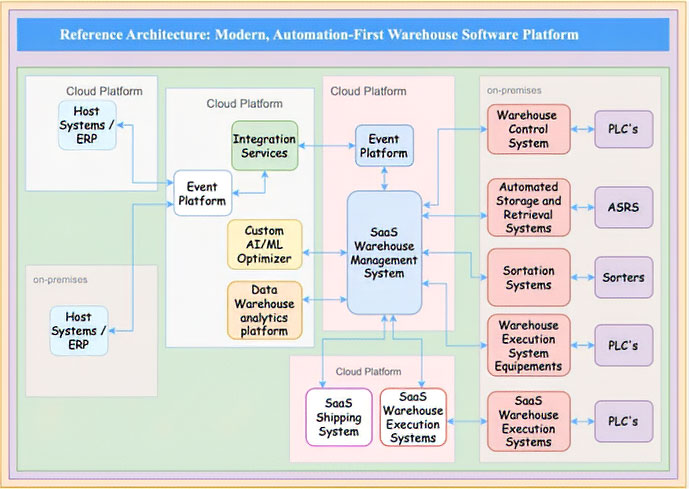
This reference architecture illustrates how a modern, automation-first warehouse can be structured as a layered, software-driven ecosystem rather than a collection of tightly coupled systems. Each layer plays a distinct role in translating business intent into physical execution while preserving scalability, resilience, and vendor flexibility.
1. Orchestration layer: SaaS warehouse management system (WMS)
At the top of the architecture sits a SaaS-based WMS, serving as the system of orchestration for the warehouse network. Rather than directly controlling automation equipment, the WMS defines what work should be performed—order priorities, inventory allocation, and fulfillment policies—while delegating how that work is executed to downstream systems.
This separation enables executives to scale capacity, introduce new automation technologies, or modify fulfillment strategies without destabilizing core warehouse operations. By operating as a cloud-native orchestration hub, the WMS provides enterprise-wide visibility while supporting rapid deployment across facilities.
2. Integration layer: Event-driven, vendor-neutral connectivity
Beneath the WMS, an event-driven integration layer connects planning systems, execution platforms, and automation software through well-defined business events. This layer replaces rigid point-to-point integrations with asynchronous communication, allowing systems to operate independently while remaining coordinated.
By enforcing vendor-neutral contracts and isolating state ownership, the integration layer absorbs variability in vendor behavior, reduces latency sensitivity, and enables the platform to scale throughput without cascading failures. This design is foundational to operating automation-first warehouses under peak conditions.
3. Execution layer: Warehouse execution and control systems
Closer to the physical environment, warehouse execution systems (WES) and warehouse control systems (WCS) translate orchestration intent into machine-level actions. These systems manage sequencing, buffering, and real-time coordination across automation assets such as goods-to-person systems, sorters, conveyors, and automated packing.
Locating execution logic near the equipment improves operational resilience, allowing facilities to continue operating during transient cloud or network disruptions while maintaining alignment with upstream orchestration decisions.
4. Intelligence layer: Analytics, optimization, and AI
Surrounding the core operational layers is an intelligence layer composed of analytics platforms and optional AI/ML optimizers. This layer transforms operational data into predictive insights, enabling organizations to optimize labor, throughput, and inventory flow proactively rather than reactively.
By decoupling optimization from execution, the architecture allows advanced decision-making capabilities to evolve independently, future-proofing the warehouse as fulfillment complexity continues to increase.
Takeaways
• Automation success is an architecture problem, not a hardware problem.
As automation density increases, the primary risk shifts from equipment performance to software orchestration and integration design.
• The SaaS WMS must act as an orchestrator, not a controller.
Treating the WMS as a coordination layer—rather than direct automation control—improves scalability, resilience, and vendor flexibility.
• Event-driven integration is foundational, not optional.
High-throughput, automation-first warehouses require asynchronous, event-based communication to absorb volume spikes and avoid cascading failures.
• Vendor neutrality preserves long-term strategic flexibility.
Loosely coupled architectures reduce dependency on individual automation providers and simplify future expansion or replacement.
• Future-proofing requires policy-driven design.
Encoding operational behavior through configurable policies—rather than hard-coded logic—enables continuous adaptation as volumes, channels, and fulfillment strategies evolve.
• Reframing the WMS as a cloud-native orchestration hub shifts automation investment from fixed CAPEX to scalable OPEX, improving responsiveness to seasonal demand.
Implications for supply chain & technology leaders
For executives overseeing large-scale warehouse automation investments, the implications are clear. Automation-first fulfillment strategies must be governed as software platform programs, not as collections of isolated equipment deployments. This requires elevating software architecture, integration design, and orchestration ownership to the same level of executive attention traditionally given to mechanical automation and facility design.
Leaders should ensure that SaaS WMS platforms are positioned as systems of orchestration, with clear execution boundaries defined between planning, integration, and automation control layers. Investment decisions should prioritize event-driven, vendor-neutral integration capabilities that preserve long-term flexibility and reduce dependency on individual automation providers. Finally, organizations must adopt policy-driven operating models that allow fulfillment behavior to evolve without repeated system rework, enabling automation platforms to scale sustainably as volume, channels, and customer expectations continue to change.
About the author
Muruganandham Kalimuthu is a principal engineer and software architect at a major U.S. retail company, with experience designing both custom, in-house warehouse management systems and large-scale, SaaS-based WMS and automation platforms. He has led greenfield automation initiatives as well as brownfield modernization programs involving legacy warehouse stacks and phased SaaS adoption across high-volume retail fulfillment networks.
SC
MR


More Warehouse Transformation
 Explore
Topics
Business Management News
- What options do you really have? Shaping the supply chain resilience funnel
- Nexus suppliers: Hidden anchors of resilience in decentralized supply chains
- Finding the ROI in supply chain education
- Managing human and AI teams across the supply chain
- Risk sharing is the new advantage in capital project delivery
- The AI-empowered supply chain leader
- More Business Management
Latest Business Management Resources

Subscribe

Supply Chain Management Review delivers the best industry content.

Editors’ Picks



